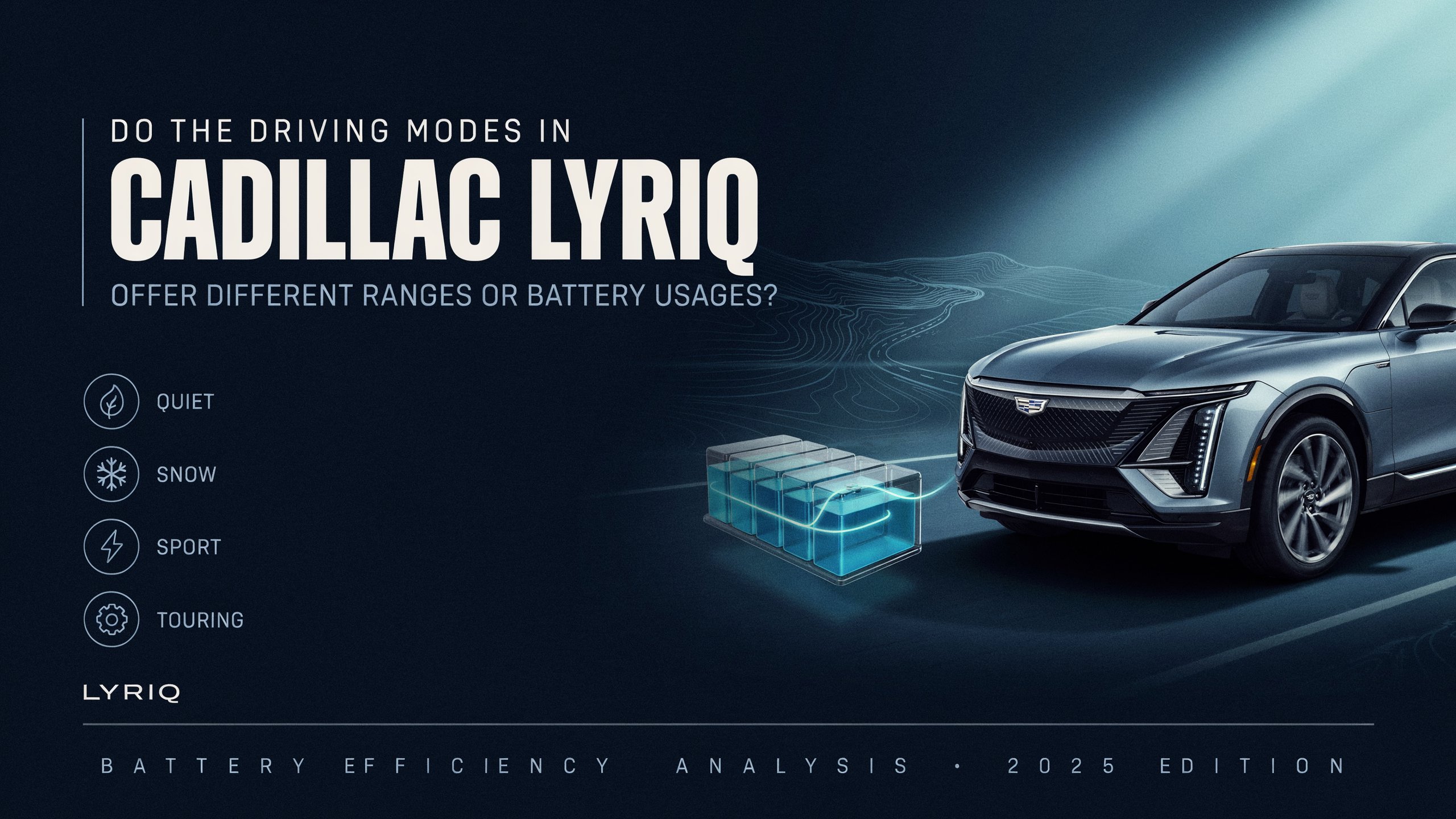
No, Cadillac does not publish separate EPA range ratings for the LYRIQ’s Tour, Sport, Snow/Ice, or My Mode settings. The vehicle uses the same battery capacity, while each mode changes aspects of how the LYRIQ responds to the driver and road conditions. Those changes can influence real-world electricity consumption and the range you see on a particular trip.
The important distinction is between a different official range rating and a different real-world energy result. Cadillac lists the 2026 LYRIQ at up to 326 miles of EPA-estimated range for single-motor RWD models and up to 319 miles for dual-motor AWD models, but those figures are not separated by drive mode. Cadillac instead identifies factors such as acceleration, speed, weather, tire pressure and vehicle maintenance as influences on range.
At a Glance: Cadillac LYRIQ Range and Drive Modes
| Feature | Verified detail |
|---|---|
| Vehicle | Cadillac LYRIQ |
| Model covered | 2026 LYRIQ |
| Powertrain options | Single-motor RWD / dual-motor AWD |
| Battery | 102 kWh rated energy capacity |
| Maximum RWD range | 326 miles EPA-estimated |
| Maximum AWD range | 319 miles EPA-estimated with standard 11.5 kW charging configuration |
| Tour Mode | Everyday driving, smooth ride calibration |
| Sport Mode | Sharper response, enhanced road connection and steering |
| Snow/Ice Mode | Helps reduce wheel spin on slippery surfaces |
| My Mode | Driver-configurable accelerator, steering, braking and sound settings |
| Separate EPA range by drive mode? | No published separate rating |
| Regenerative braking | Available through One-Pedal Driving and Regen on Demand |
| Daily charging guidance | Cadillac recommends charging to 80% for typical daily use |
Sources: Cadillac LYRIQ specifications, features and support materials.
What the LYRIQ Driving Modes Actually Change
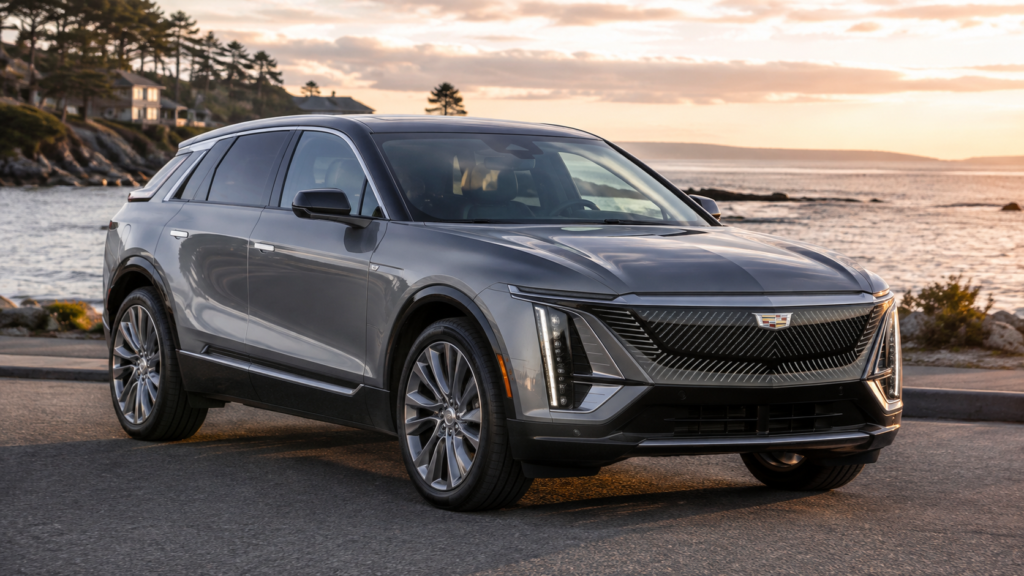
The LYRIQ’s drive-mode system is designed primarily to alter the vehicle’s driving characteristics rather than create separate battery capacities or fixed range maps. Cadillac describes Tour as the predominant everyday mode, Sport as a sharper performance-oriented setting, Snow/Ice as a traction-focused mode and My Mode as a configurable setting.
That means selecting Sport does not suddenly give the LYRIQ a smaller battery, while choosing Tour does not physically increase the battery’s capacity. Instead, the selected calibration can change accelerator response, steering feel, braking response and other characteristics that can influence how the vehicle is driven.
| Drive mode | Main purpose | Likely effect on energy use |
|---|---|---|
| Tour | Smooth everyday driving | Generally the best choice for consistent efficiency |
| Sport | Faster response and stronger performance feel | Can increase consumption when it encourages harder acceleration |
| Snow/Ice | Reduce wheel slip on slippery roads | Consumption depends heavily on road, tires, temperature and driving conditions |
| My Mode | Personalized response settings | Depends on the settings selected and how the vehicle is driven |
Cadillac’s general Driver Mode Control guidance describes Tour/Normal as the most economical setting, but Cadillac does not provide a fixed percentage showing how much more or less efficient a LYRIQ is in one mode versus another.
Does Sport Mode Use More Battery?
Sport Mode can lead to higher battery consumption, but it is not because Cadillac assigns Sport a lower official range. The main issue is driver behavior and the more immediate accelerator response that Sport is intended to provide.
Cadillac says Sport mode is calibrated for a stronger feeling of road connection, more immediate torque response and improved steering at higher speeds. In an EV such as the LYRIQ, repeated hard acceleration requires substantial electrical power, so using that response aggressively can reduce miles per charge compared with calmer driving.
A driver could therefore use Sport Mode and still achieve respectable efficiency by accelerating gently and maintaining moderate speeds. Conversely, someone in Tour Mode can consume considerably more energy by driving quickly, making frequent hard accelerations and carrying extra load.
This is why the most accurate answer is that Sport changes the potential driving behavior more than it changes a fixed energy budget.
Is Tour Mode the Best for Range?
Tour is generally the sensible choice when the goal is smooth, predictable everyday efficiency. Cadillac describes Tour as the predominant LYRIQ mode for everyday driving, with calibration focused on a smooth ride, while its broader Driver Mode guidance identifies Tour/Normal as the most economical setting.
That does not mean Tour guarantees the highest possible range on every journey. Temperature, speed, acceleration, road conditions, tire pressure, terrain, payload and climate control can have a much larger effect than simply choosing one drive mode over another.
For a long highway trip, for example, steady moderate-speed driving in Tour may be more efficient than repeated acceleration in Sport. But a properly driven LYRIQ in Sport could still outperform an inefficiently driven vehicle in Tour.
What About Snow/Ice Mode and Battery Consumption?
Snow/Ice mode is designed for traction management, not maximum range. Cadillac says this setting is intended to help prevent wheel spin on snowy or otherwise slippery surfaces, and its general Driver Mode guidance explains that Snow/Ice changes the pedal map to slow acceleration and torque response.
In real winter driving, energy use can be affected by far more than the mode itself. Cold temperatures can reduce EV range, while snow, slush, wind and lower road temperatures can increase rolling resistance and overall energy demand.
There is also an important safety consideration. Cadillac specifically says One-Pedal Driving is not recommended on slippery roads such as wet, snowy or icy surfaces, even though regenerative braking remains an important part of LYRIQ operation.
So Snow/Ice mode should be viewed as a traction and controllability feature, not as an efficiency mode.
Does My Mode Change Range?
My Mode is more complicated because the driver can customize the vehicle’s behavior. Cadillac says My Mode can alter characteristics including accelerator responsiveness, steering feel, braking responsiveness and Electric Vehicle Sound Enhancement.
Because My Mode is configurable, there is no single consumption profile that can be assigned to it. A conservative My Mode setup may feel close to the everyday behavior of Tour, while a more aggressive accelerator setting could encourage stronger acceleration and therefore higher electrical demand.
The best way to think about My Mode is as a customization tool, not as a hidden range setting.
Do Driving Modes Change the LYRIQ’s Battery Capacity?
No. The mode selector does not change the physical battery capacity of the vehicle. Cadillac lists the LYRIQ’s battery platform at 102 kWh of rated energy capacity for the 2026 model specifications.
The battery itself remains the same regardless of whether the driver chooses Tour, Sport, Snow/Ice or My Mode. What changes is how the vehicle manages and responds to inputs, while actual consumption changes according to the overall driving conditions and energy demand.
This distinction matters because drivers sometimes interpret a changing range estimate on the dashboard as proof that a mode has created a separate battery range. In reality, the displayed estimate can react to recent driving patterns and other conditions rather than representing a permanent mode-specific rating.
How Regenerative Braking Affects LYRIQ Range
Regenerative braking is more directly connected to efficiency than the basic choice between Tour and Sport. Cadillac describes the LYRIQ’s regenerative braking system as a way to capture braking energy and return it to the battery.
The LYRIQ also offers Regen on Demand, operated through a steering-wheel-mounted paddle, and One-Pedal Driving with selectable levels. Cadillac’s One-Pedal guide lists Off, On/Normal and High settings, with High providing greater deceleration when the accelerator is released.
| Efficiency-related feature | What it does |
|---|---|
| Regen on Demand | Uses regenerative braking to recover some vehicle momentum as electrical energy |
| One-Pedal Driving Normal | Adds moderate regenerative deceleration when the accelerator is released |
| One-Pedal Driving High | Provides stronger deceleration and regeneration |
| Friction braking | Uses conventional braking when regeneration alone is insufficient |
Regeneration does not create free energy. Energy is lost during the overall conversion process, but recovering some kinetic energy that would otherwise be dissipated through conventional braking can improve efficiency.
Cadillac also notes that regenerative braking can be limited when the battery is very cold, extremely hot or near full charge.
Why the Same LYRIQ Can Show Different Range in Different Trips
A drive-mode comparison becomes clearer when the wider range factors are considered. Cadillac specifically lists rate of acceleration, travel speed, vehicle maintenance, tire pressure and ambient weather conditions as factors affecting LYRIQ range.
Temperature is particularly important for EVs because extreme conditions can influence battery performance and cabin climate demand. Terrain, headwinds, passenger and cargo weight, road surface and stop-and-go traffic can also change the energy required to complete the same route.
That is why two LYRIQs with identical battery specifications can produce different real-world miles-per-charge results.
Official LYRIQ Range Figures vs. Drive-Mode Effects
The published figures help separate what Cadillac officially rates from what drivers may experience in practice.
| Item | Officially published? | What it means |
|---|---|---|
| 326-mile RWD maximum range | Yes | EPA-estimated maximum for applicable 2026 LYRIQ RWD configuration |
| 319-mile AWD maximum range | Yes | EPA-estimated maximum for applicable AWD configuration |
| Separate Sport range | No | Cadillac does not publish a dedicated Sport-mode EPA range |
| Separate Tour range | No | No standalone Tour-mode EPA rating |
| Separate Snow/Ice range | No | No dedicated Snow/Ice range figure |
| Separate My Mode range | No | Settings vary, so there is no single rating |
| 102 kWh rated battery capacity | Yes | Published battery capacity for the LYRIQ platform |
| Regenerative braking | Yes | Designed to recover some energy during deceleration |
Cadillac’s published specifications also show that powertrain configuration itself matters. The 2026 LYRIQ’s single-motor RWD version is listed at up to 326 miles EPA-estimated, while the dual-motor AWD version is listed at up to 319 miles in the relevant configuration.
That difference is much more meaningful as an official specification than any unsupported claim that Sport, Tour or Snow/Ice has a particular percentage impact on range.
What Mode Should You Use for Maximum Range?
For everyday driving where efficiency is the priority, Tour is the most straightforward choice. Its smooth calibration fits normal city and highway use, and Cadillac’s general guidance identifies Tour/Normal as its most economical drive-mode setting.
For maximum practical range, however, the driver should pay attention to the entire operating environment:
- Keep acceleration smooth rather than repeatedly using maximum torque.
- Avoid unnecessary high-speed driving because aerodynamic energy demand rises rapidly with speed.
- Maintain correct tire pressure.
- Use regenerative braking appropriately.
- Consider weather and terrain when planning longer journeys.
- Reduce unnecessary cargo weight when practical.
- Precondition or manage the cabin strategically in extreme temperatures.
The mode selector helps, but it is only one part of the efficiency picture.
Does Charging to 80% Affect the Answer?
Charging behavior is separate from drive-mode selection, but it matters when discussing battery usage. Cadillac recommends charging the LYRIQ to 80% for daily use, while allowing drivers to charge above 80% for longer trips. Cadillac says maintaining space in the battery also allows room for regenerative braking.
This means a driver should not confuse a lower daily charge target with a drive-mode-related reduction in battery performance. An 80% charge is a battery-management recommendation, whereas Tour, Sport, Snow/Ice and My Mode are driving-calibration choices.
For a long journey, charging above 80% can provide additional usable starting range, subject to Cadillac’s guidance and the specific trip requirements.
The Bottom Line on LYRIQ Drive Modes and Battery Usage
The Cadillac LYRIQ does not have separate official range ratings for its driving modes. Tour, Sport, Snow/Ice and My Mode alter vehicle behavior and control characteristics, but the underlying battery capacity remains the same.
In practical driving, though, the selected mode can affect energy consumption indirectly. Sport may use more electricity when its sharper response results in stronger acceleration, while Tour generally encourages smoother everyday driving. Snow/Ice prioritizes traction, and My Mode can vary depending on the driver’s chosen settings.
The biggest takeaway is that drive mode is only one variable. Cadillac itself points to acceleration rate, speed, weather, tire pressure and maintenance as important factors in LYRIQ range, while regenerative braking can help recover some energy during deceleration.
Frequently Asked Questions
Do the driving modes in Cadillac LYRIQ offer different ranges?
No. Cadillac does not publish separate EPA-estimated range figures for Tour, Sport, Snow/Ice or My Mode. The published range applies to the specific LYRIQ powertrain and configuration rather than to an individual drive mode.
Which LYRIQ mode is best for battery efficiency?
Tour is the most logical everyday choice when efficiency and smooth driving are priorities. Cadillac’s broader Driver Mode Control guidance identifies Tour/Normal as the most economical setting, although the company does not publish a fixed percentage of savings for the LYRIQ.
Does Sport Mode drain the LYRIQ battery faster?
It can in real-world use, especially when its more immediate accelerator response encourages harder acceleration or faster driving. Sport Mode itself does not create a separate battery capacity or official range rating.
Does Snow/Ice Mode improve range?
No. Snow/Ice Mode is primarily designed to reduce wheel spin and improve control on slippery surfaces. Winter conditions themselves can reduce EV range, so the mode should be selected for traction and safety rather than expected efficiency gains.
Does One-Pedal Driving improve LYRIQ range?
Regenerative braking can recover some energy during deceleration, which can improve overall efficiency compared with wasting all of that energy as heat through conventional braking. Cadillac offers One-Pedal Driving and Regen on Demand, but also notes that regeneration can be limited in certain battery-temperature and state-of-charge conditions.
Also Read: CnLawBlog Explained | Origins, Content, and Credibility
About the Author